- Language courses
- English, Chinese
- Bachelor's Degree
- English, Chinese
- Master's Degree
- English, Chinese
- Doctoral (PhD) Programmes
- English, Chinese
- Accommodation from 2 000 ¥/year
CUFE · 中央财经大学

Central University of Finance and Economics accepts international students on programmes in the following fields: business, engineering, economics. Choose the level and programme that suit your goals.
Chinese language study at the university — from a few weeks to a year or longer. Suitable for those starting from scratch or preparing for the HSK before entering a main programme.
self-funded · language programme
Cost: 20 000 ¥/year
The first level of higher education: usually four years of study, specialised subjects, internships and a graduation thesis. It opens the way to working in your field and to a master's degree.
self-funded
Cost: 25 000 ¥/year
Advanced study after a bachelor's degree: research, applied projects and internships. It helps you become an expert in your chosen field and broaden your career opportunities.
self-funded
Cost: 30 000–104 000 ¥/year
Central University of Finance and Economics is located in Beijing. Nihao Study consultants keep track of the deadlines and admission requirements of this university, and you can always check the most accurate and up-to-date information on its official website. In university rankings, it is ranked 140 in China and 1333 worldwide.
Come for a face-to-face meeting: together we will go through the requirements, deadlines, documents and study options that suit you.

At the meeting we will look at your situation, tell you which documents to prepare and by when, talk about possible programmes and help you decide on the next step.
Central University of Finance and Economics (CUFE, 中央财经大学, pinyin Zhōngyāng Cáijīng Dàxué) is a Beijing university usually called the Central Finance and Economics University in Russian; this is the form established in encyclopaedic sources. Texts also use the variant 'Central Financial and Economic University', while a third version is a word-for-word calque of the English name. Within China, the university is known as 中财 (Zhōngcái) or 央财 (Yāngcái) for short.
The university is public and reports directly to the Ministry of Education of the PRC, with joint support from the Ministry of Finance and the Beijing Municipal Government. CUFE's Project 211 status and its participation in the Double First-Class (双一流) programme are confirmed. Project 985 is more nuanced: the university was in the first group of 985 innovation platforms for priority disciplines, but it was not on the main list of universities in that project, so it is not considered a fully fledged '985 university'.
This Nihao Study overview brings together CUFE's confirmed statuses and rankings, its programmes, HSK requirements, scholarship options and the admission procedure for 2026.

| Indicator | Data | What this means |
|---|---|---|
| Year founded | 1949 | among the first finance and economics universities of the People's Republic of China |
| Academic structure | 27 schools | besides economics — law, management, statistics, IT and the humanities |
| Registered students | 18 345 | the figure covers different levels of study |
| Bachelor's students | 10 119 | the largest group |
| Teaching staff | 1 213 | university data |
| Campus | 102.72 hectares | the university occupies several sites in Beijing |
| Library holdings | 8.69 million items, including e-books | resources on economics, law and management |
| Main Double First-Class discipline | applied economics | the second-round list names the discipline, not the university as a whole |
The university also gives more recent aggregated figures: about 10,000 bachelor's students, 6,100 master's students and 1,000 doctoral students, plus 400 international students. Figures on different pages differ because of the date and counting method, so it is better to judge the university's size by orders of magnitude rather than by a single number.
The university traces its history back to 6 November 1949; at first it reported to the Ministry of Finance. Over the following decades the institution changed its form and name several times: first it was the North China Tax School, then the Central Tax School, later the Central Institute of Public Finance, the Central Institute of Finance and Economics and, finally, the Central Institute of Finance. The university received its current English name, Central University of Finance and Economics, when it was renamed in 1996, and in 2000 it came under the direct administration of the Ministry of Education.
Its position in the national system grew stronger step by step: in 2005 CUFE was included in Project 211, in 2006 it joined the first group of Project 985 innovation platforms for priority disciplines, and since 2017 it has taken part in Double First-Class. In the second-round 双一流 list, published by the Ministry of Education in 2022, applied economics was again confirmed for CUFE. Over its history the university has produced more than 190,000 graduates.
World rankings rate CUFE differently: overall tables reward a large volume of natural science publications, while subject rankings better reflect its finance and economics specialisation. So applicants should compare several systems at once.
| Ranking | Position | What the result means |
|---|---|---|
| ShanghaiRanking ARWU 2025 | 801–900 worldwide | overall ranking based on research indicators |
| ShanghaiRanking 2026, finance and economics universities in China | 2nd place | comparison with Chinese universities of the same profile |
| QS by Subject 2026 | 184th place | the subject position closest to CUFE's profile |
| QS Asia | 597th place | regional sample, broad methodology |
| CWUR 2026 | 1604th out of 21,291 | CUFE is in the top 7.6 per cent of the sample |
| EduRank 2026, economics | 48th in China, 543rd worldwide | assessment based on publications and citations (bibliometrics) |
Times Higher Education has overall and subject rankings built on different sets of indicators, so when choosing a programme it is better to rely on the confirmed figures in the table. Individual achievements show up in ESI: economics and business entered the global top 1 per cent back in the 2020 edition, and in January 2026 psychology joined them — it is now the university's fourth discipline in the ESI top 1 per cent.
In the fourth national discipline evaluation, CUFE's applied economics received an A+ grade and placed in the top 2 per cent of its group. This is the core of the university: taxation, finance, insurance, economic policy, international trade and regional economics are studied here in connection with the practical tasks of government and business. It is applied economics that holds Double First-Class status.
In its 2026 subject analytics, EduRank ranks CUFE's actuarial science 7th in China and 137th worldwide, and its research in investment banking and stock trading 13th in China and 144th worldwide. Such figures do not replace the accreditation of a specific programme, but they explain why the university is chosen by those interested in quantitative finance, insurance and risk management.
CUFE offers 54 bachelor's programmes. At master's level there are 16 first-level academic disciplines and 21 categories of professional programmes, and at PhD level 7 first-level disciplines. The list for international bachelor's students is not limited to finance and accounting: it includes law, psychology, computer science, information systems and information security. This way economics can be combined with data, regulation and digital products.
The finance side of the university is made up of the schools of finance, accounting, insurance, public finance and taxation, economics, and international economics and trade. International students can enrol in bachelor's programmes in finance, accounting, public finance, insurance, financial management, actuarial science, economics and international trade.
The management and social sciences cluster includes public and urban administration, business administration, human resource management, sociology, international politics and applied psychology. For those who want more than classic finance, there are law, mathematics, applied statistics, English, translation, cybersecurity and e-commerce.
| Level | Language and duration | Sample programmes |
|---|---|---|
| Bachelor's Degree | Chinese or English, 4 years | Finance, accounting, taxation, international trade, actuarial science, IT |
| Master's Degree | Usually 2 or 3 years; Chinese or English | Finance, investment, digital economy, regional economics, international law |
| PhD | Chinese or English, 4 years | Insurance, public finance, management, law, regional economics |
| Foundation programme | 1 semester or 1 academic year | Chinese language, business Chinese, mathematics, academic adaptation |
| Chinese language courses | 1 year, 1 semester or 2 to 4 weeks | General and business Chinese, HSK preparation, cultural programme and excursions |
For the 2026 intake, Chinese-taught bachelor's programmes required HSK 5 with a score of at least 180. At the same time, CUFE launched an English-taught bachelor's programme in finance with its own requirements, so the HSK requirement cannot be applied to the whole catalogue — check the language and requirements in the description of the specific programme.
Chinese language courses are useful for those who need business vocabulary: the programme includes an economic context, HSK preparation, culture classes and trips around Beijing. Exam dates and registration windows change, so check them against the official HSK schedule.
Besides the tuition fee, your budget should include the application fee, the annual residence permit processing and compulsory medical insurance. The final amount depends on the chosen programme and room type, and the current rates are published by the university itself.
| Cost item | What to check |
|---|---|
| Dormitory place | the monthly total depends on the rate and the number of days charged |
| Medical insurance | compulsory payment, paid separately |
| Residence permit | paid after the documents are processed |
One of CUFE's sites is in Haidian District at 39 South College Road (postcode 100081). The Shahe campus is in Changping District: 1 Shunsha Road (Shahe section), postcode 102206. International applicants are received at CUFE Tower on the Haidian site. Check with the university which campus your group will study and live on.
Your field of study and citizenship, age and HSK level, as well as the deadlines and method of application, should be checked in advance against the requirements of the chosen programme. Do not put off applying to the university itself until the scholarship competition results are announced.
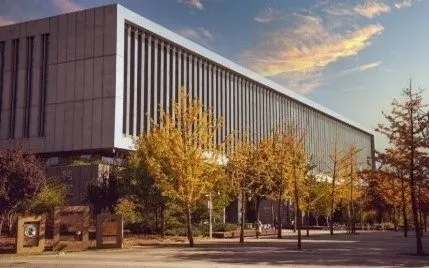
Student life at CUFE takes place on two sites: the central one in Haidian and the more spacious one in Shahe (Changping District). The Shahe library covers 30,501 square metres, has capacity for 1.7 million volumes and is equipped with 3,019 reader seats. Inside there are multimedia halls, discussion rooms, an exhibition space, conference rooms and reading areas.
Photos of the campus show the stadium, teaching buildings, green avenues and dormitory rooms. Dormitory places are allocated by the university. If you choose to study in the capital, compare CUFE with other universities in Beijing and bear in mind that travelling between districts takes time.
| University and Chinese name | Type | Main focus |
|---|---|---|
| Central University of Finance and Economics, CUFE, 中央财经大学 | Project 211, Double First-Class; under the Ministry of Education | finance, applied economics, taxation, insurance |
| Capital University of Economics and Business, CUEB, 首都经济贸易大学 | Beijing municipal university | economics, management, business |
| University of International Business and Economics, UIBE, 对外经济贸易大学 | Project 211, Double First-Class; under the Ministry of Education | international trade, business, languages |
| Beijing Technology and Business University, BTBU, 北京工商大学 | municipal research university | business, food science, engineering |
CUFE's main distinguishing feature is its direct link with the Ministry of Finance and its clearest focus on public finance and applied economics. It makes more sense to compare it with UIBE on international trade and English-taught business programmes. CUEB and BTBU belong to the Beijing municipal university system and have a broader, municipal profile.
The standard Russian form is the one meaning ‘Central Finance-and-Economics University’. The spelling without a hyphen and the variant meaning ‘Central Financial and Economic University’ appear in searches but are not standard. The Russian ‘Central University of Finance and Economics’ is a calque of the English. Central University of Finance and Economics is the official international name, and CUFE is the official abbreviation. Zhongcai (中财) and Yangcai (央财) are Chinese short forms, and the full Chinese name 中央财经大学 is read as Zhōngyāng Cáijīng Dàxué.
It is a public finance and economics university in Beijing, directly under the Ministry of Education of the PRC. It is part of Project 211 and the Double First-Class programme.
CUFE is not on the main list of Project 985 universities. It took part in the 985 innovation platform for priority disciplines, which is a separate support mechanism.
Yes. The 2026 catalogue includes an English-taught bachelor's programme in finance, several master's programmes and PhD options taught in English.
For Chinese-taught bachelor's programmes in the 2026 intake: HSK 5 with 180 points or more. Check that your certificate will not expire, and compare upcoming exam dates with the official HSK calendar.
Yes, in the second round of Double First-Class, CUFE holds applied economics.
The fee for a dormitory place is charged per day and depends on the room type; the university publishes current rates on cufe.edu.cn.
Yes. For strong candidates CUFE publishes full CSC scholarships, in particular the High Level Graduate Program and Silk Road. Competition is tough, and the list of majors changes from intake to intake.
HSK preparation is part of the language programme. Whether the exam is held on campus itself, however, must be checked against the official list of centres when you register: the university's page does not confirm a regular exam schedule.
The main site and the international admissions office are at 39 South College Road, Haidian, Beijing, 100081. The Shahe campus is in Changping: 1 Shunsha Road, Shahe, Beijing, 102206. Plan your route to the campus stated in your admission notice.
CUFE is most closely linked to public finance, taxation and applied economics. UIBE specialises in international trade and foreign economic business, while CUEB is a Beijing municipal university with a broad economics and management profile.
Usually you need a passport and application form, a school-leaving certificate with a full transcript of grades, an HSK certificate and a CSCA result, as well as a medical form, a police clearance certificate, a study plan and 2 recommendations. Before applying, check the official announcement for your intake.
Beijing (北京) is the capital of China and a major centre of education: the city has more than 90 universities, among them Peking University and Tsinghua University, which rank in the country's top 2. Here you can see the Forbidden City and the Great Wall of China, as well as the modern tech district of Zhongguancun, known as China's Silicon Valley.
Studying in Beijing goes hand in hand with good career prospects: the city hosts the headquarters of major companies and research centres, getting around is easy (the metro has 22 lines), and cultural life is very rich. Parents should know that the capital's infrastructure is highly developed, there are international clinics with Russian-speaking staff, many direct flights leave the city, and students are supported by a well-established system: dormitories are located right on the guarded university campuses.
You work with Nihao Study specialists. They will help you put together a portfolio and a set of documents, draw up a study plan and choose a university or college and a specialty that genuinely interest you.
We take care of every stage of admission, from choosing to enrolment
We will gather, prepare, certify and send your documents to the institution
We will show the admissions committee your strengths
We run training sessions and courses so you can prepare with more confidence
We will help you settle in at the start of your studies and keep moving forward
Nihao Study specialists select universities and colleges that match the applicant's goals and means. We make sure the teachers are practitioners and that the knowledge will be useful in your profession.
We examine curricula, talk to students and teachers and look at which specialties employers need, and use this information to select options for the applicant.
Advisers guide the applicant from the first consultation to enrolment, help build a plan and spot mistakes in time that could get in the way.
The cost of our support depends on the programme and the partner university; you'll get an exact quote after a free consultation.
Get a quoteA free 15-minute consultation: together we will choose a university or college and a programme that suit your goals and budget.
Apply with peace of mind: we handle the documents, deadlines and correspondence with admissions committees, and you save time and energy.
Don't want to wait for a call? Message us in the chat.
Message us in chat