- Language courses
- English, Chinese
- Bachelor's Degree
- English, Chinese
- Master's Degree
- English, Chinese
- Doctoral (PhD) Programmes
- English, Chinese
- Accommodation from 2 000 ¥/year
PKU · 北京大学
Peking University accepts international students on programmes in the following fields: business, engineering, medicine, education, law, economics. Choose the level and programme that suit your goals.
Chinese language study at the university — from a few weeks to a year or longer. Suitable for those starting from scratch or preparing for the HSK before entering a main programme.
self-funded · language programme
The first level of higher education: usually four years of study, specialised subjects, internships and a graduation thesis. It opens the way to working in your field and to a master's degree.
self-funded
Advanced study after a bachelor's degree: research, applied projects and internships. It helps you become an expert in your chosen field and broaden your career opportunities.
self-funded
Peking University is located in Beijing. Nihao Study consultants keep track of the deadlines and admission requirements of this university, and you can always check the most accurate and up-to-date information on its official website. In university rankings, it is ranked 2 in China and 30 worldwide.
Come for a face-to-face meeting: together we will go through the requirements, deadlines, documents and study options that suit you.

At the meeting we will look at your situation, tell you which documents to prepare and by when, talk about possible programmes and help you decide on the next step.
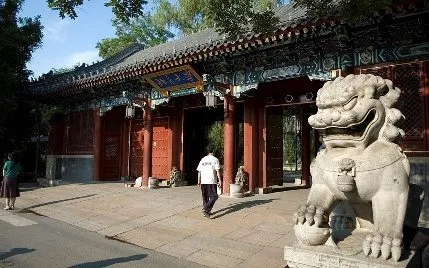
Peking University (PKU, 北京大学) is a public research university and one of China's leading institutions. It is located in the north-west of Beijing, in Haidian District. In everyday speech and among Chinese students it has an affectionate short name, Beida (北大, Běidà). In Russian it is sometimes called 'University of Beijing', while international rankings use the official abbreviation PKU, which goes back to the historical postal romanisation Peking.
The main campus, Yanyuan, is at No. 5 Yiheyuan Road, Haidian District, Beijing, 100871. It occupies the grounds of former Qing-dynasty imperial gardens near the Summer Palace. The university dates its history from 11 June 1898, when the Guangxu Emperor, during the Hundred Days' Reform, established the Imperial University of Peking by decree.
Below is information useful to applicants: key figures, rankings, faculties, accommodation, scholarships, the admission procedure and Beijing universities that are easily confused with PKU. You can ask questions about admission at a Nihao Study consultation.

| Item | Data | Notes |
|---|---|---|
| Founded | 1898 | One of China's first modern national universities |
| Number of faculties | 8 | Natural sciences, information science, engineering, humanities, social sciences, economics and management, interdisciplinary studies, health sciences |
| Schools and departments | 55 | Spread across eight faculties |
| Total students | about 48,600 | All levels: bachelor's, master's and doctoral |
| International students | about 2,500 | Only students on full-time degree programmes; short-term exchanges are not counted |
| Faculty and staff | over 12,600 | Including more than 123 academicians of the Chinese Academy of Sciences and the Chinese Academy of Engineering |
| Programmes for international students | 137 bachelor's, 59 master's, 59 doctoral | In total across all schools and departments |
| Library holdings | about 8 million items | Considered the largest university library in Asia |
| Campus area | 274 hectares | Site of former Qing imperial gardens, Haidian District |
| University code in the CSC system | 10001 | Entered in the Chinese Government Scholarship application |
The idea of founding a university in the capital emerged after China lost the Sino-Japanese War of 1894 and 1895. Kang Youwei, Liang Qichao and Yan Fu, the reformers of the day, pushed for a renewal of the education system. On 11 June 1898, during the Hundred Days' Reform, the Guangxu Emperor approved the establishment of the Imperial University of Peking (京师大学堂), and on 3 July he approved its charter, drafted by Liang Qichao. The American missionary William Alexander Parsons Martin was appointed its first president. The official opening took place on 31 December 1898, when the university had just over 160 students.
In 1912, after the 1911 Xinhai Revolution and the founding of the Republic of China, the institution was renamed Peking University. Its teacher-training department eventually separated and became the independent Beijing Normal University. From 1916 to 1927 the university was led by its president Cai Yuanpei. Under him, PKU became the centre of the New Culture Movement and the 4 May Movement of 1919; Li Dazhao and Chen Duxiu, later founders of the Communist Party of China, taught and studied here at the time.
The nationwide reform of higher education in 1952 merged Peking University with the humanities-focused Yenching University, and PKU moved to its present site, Yanyuan, the former Yenching University campus together with the imperial gardens. The university's recent history includes taking part in the first rounds of Project 211 (1996) and Project 985 (1998), and since 2017 PKU has been in Category A of the Double First-Class programme.
In global rankings PKU consistently stays within the top 15, and among universities in mainland China it ranks first or second, usually behind only Tsinghua University, its main partner and rival. Positions vary between rankings because their methodologies weigh different things: citations, employer opinion, the share of international students and research indicators.
| Ranking | Position and year | What this means in practice |
|---|---|---|
| QS World University Rankings | 14th, 2026 | Leads mainland Chinese universities together with Tsinghua |
| THE World University Rankings | 13th, 2026 | Second in Asia, up 28 places in ten years |
| ARWU, Shanghai Ranking | 23rd, 2025 | The university's research metrics are stronger than its reputation survey results |
| CWUR | 51st in the world, 2026 | Second in China after Tsinghua |
| U.S. News Best Global Universities | 25th, 2025 and 2026 | One of the few Chinese universities in the world top 30 |
| ESI, global top 1 per cent | 21 disciplines | Broad subject coverage: not just one strong department, but many |
Its Double First-Class Category A status deserves a special mention: it is the higher of the programme's two categories. It goes hand in hand with PKU's historical participation in Projects 211 and 985, which were formally restructured in 2017. The 23rd place in ARWU is the university's overall position; in subject rankings, a particular discipline may rank higher or lower.
PKU is known as a university that sets the tone in Chinese humanities while maintaining a high standard in fundamental research. Below are the three components of this reputation.
Historically, PKU produced many members of China's intellectual and political elite: Hu Shi, Li Dazhao and Chen Duxiu studied and taught here, and president Cai Yuanpei established the principle of academic freedom that largely shaped the Chinese humanities in the 20th century. Today the university's strengths include the Law School, the School of International Studies and Yenching Academy. The latter runs a global interdisciplinary master's programme in China Studies and each year admits about 120 Yenching Scholars. For almost all admitted students, the Yenching Scholarship covers virtually all costs: tuition, flights, accommodation and a monthly stipend.
In the Nature Index, which evaluates research in the natural and life sciences, PKU regularly ranks among the world's top 5 universities. The university runs 420 research units, including 7 State Key Laboratories and 5 national engineering research centres. On this basis, 21 PKU disciplines have entered the global ESI top 1 per cent, from chemistry and materials science to clinical medicine.
Together with Tsinghua University, PKU forms the core of the C9, an informal league of nine leading Chinese research universities often compared to the Ivy League. As PKU was the first comprehensive national university of modern China, in its early years it also served as the country's highest education authority. Historical seniority is matched by scale: 8 faculties and 55 schools and departments cover almost every field of modern science, from fundamental physics to public health.
PKU has eight faculties: natural sciences, information science, engineering, humanities, social sciences, economics and management, interdisciplinary studies, and health sciences. Together they bring together 55 schools and departments, offering international students 137 bachelor's, 59 master's and 59 doctoral programmes.
The university's main business school is the Guanghua School of Management, regarded as one of the leading schools in Asia for MBA and master's programmes in finance. There are also the National School of Development and HSBC Business School on the Shenzhen campus, which focuses on international English-taught programmes. These schools run the Finance, Business Administration and International Economics and Trade programmes.
Medicine is represented by the Health Science Center (PKUHSC), which includes the medical schools and 6 affiliated clinical hospitals. The Computer Science and Technology programme is run by the School of Electronics Engineering and Computer Science and the engineering faculty.
On-campus dormitory places go first to government scholarship holders, while self-funded students more often pay for their accommodation. International students have two main options. The first is the Shaoyuan guesthouse on campus, with 212 rooms in various categories, from standard rooms to suites. The second is the Zhongguanyuan Global Village complex outside the south-east gate, where Building 1 (203 rooms) and Building 9 (176 rooms) are allocated to international students.
The final cost of accommodation depends on the building, the room category and whether the student has a scholarship discount, so it is best to check current prices on the university's official website before moving in.
As on most Chinese campuses, access to PKU dormitories is controlled, with a pass system and security staff. The south and south-east gates lead directly to Zhongguanyuan Global Village. It is best to check the condition and layout of rooms just before moving in, as renovations and furniture upgrades take place at different times in different buildings.
The main route to free study is the Chinese Government Scholarship (China Scholarship Council, CSC). At PKU it is available in two formats. Type A is a bilateral programme: documents are submitted through the Chinese embassy or consulate in the applicant's country. Type B is the university's own quota: the application is handled entirely by PKU's international office using the institutional code 10001. Both options cover tuition, accommodation and medical insurance, and also include a monthly stipend for master's and doctoral students.
The CSC has age limits: master's applicants must be no older than 35, and doctoral applicants no older than 40. Applicants must not be Chinese citizens and must provide proof of good health. PKU usually starts accepting applications for the 2026 scholarship in spring, and the decision arrives by email in summer.
A separate and far more generous option is Yenching Academy. Each year, around 120 Yenching Scholars are selected from thousands of applicants for the interdisciplinary master's programme in China Studies; in the latest intake only 2.7 per cent of applicants were successful. The Yenching Scholarship pays for flights, tuition, accommodation, medical insurance and a monthly stipend for virtually all admitted students. PKU also offers its own scholarship for new international students, and the Beijing municipal government offers a regional scholarship; their conditions should be checked at the time of application.
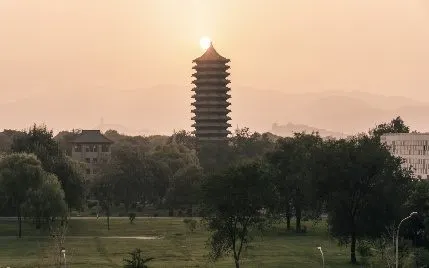
The PKU library holds about 8 million items and is described as the largest university library in Asia. Weiming Lake is considered the symbol of the campus; this artificial lake dates back to the layout of the imperial gardens. In summer lotuses bloom on it, in autumn its banks are covered in golden leaves, and in winter it is turned into an ice rink. Nearby rises the 37-metre Boya Pagoda, built in 1924 as a water tower styled after ancient Liao dynasty pagodas. The pagoda's reflection in the lake is one of the most recognisable views of any Chinese university.
The campus is also home to the Arthur M. Sackler Museum: opened in 1993, it was China's first university museum of archaeology and art. Its collection includes more than 10,000 objects, from stone tools from the Zhoukoudian site to porcelain and paintings. Among the sports facilities, the PKU Gymnasium stands out: it was built for the 2008 Olympics and hosted the table tennis tournaments (6,000 permanent seats plus 2,000 temporary ones), and after the Games the building was converted into a fitness complex with a swimming pool.
Haidian, where the campus is located, has historically been regarded as Beijing's centre of science, education and technology; the Summer Palace and the Zhongguancun technology park are nearby.
In translations and in everyday speech, Peking University is sometimes confused with other universities in China's capital. Here are the main ones.
| University and Chinese name | Status | Main focus |
|---|---|---|
| Peking University, PKU, 北京大学: the university this article is about | National; Double First-Class A, C9, 211 and 985 | Law, business, medicine, humanities and natural sciences |
| Beijing University of Technology, BJUT, 北京工业大学 | Municipal, founded in 1960, not part of 211 or 985 | Applied technology and engineering |
| Beijing Institute of Technology, BIT, 北京理工大学 | National; 211 and 985, one of the "Seven Sons of National Defence" | IT, mechanical engineering, weapons systems |
| Beijing Normal University, BNU, 北京师范大学 | National; 211 and 985, grew out of the teacher-training department (1902) of the same Imperial University | Psychology, education, natural sciences and humanities |
| Renmin University of China, RUC, 中国人民大学 | National; Double First-Class A, 211 and 985 | Law, economics, journalism, sociology |
PKU is most often confused with BJUT, Beijing University of Technology, because "Beijing University" and "Peking University" sound alike in English. However, BJUT is a municipal engineering university without 211 or 985 status, whereas PKU is a national university and a member of the C9. Closest to PKU in origin is Beijing Normal University: its predecessor was the teacher-training department of that same Imperial University of Peking, but today it specialises in education and psychology. Renmin University of China and Beijing Institute of Technology are independent national 985-level universities with different specialisations: social sciences at RUC and defence engineering at BIT.
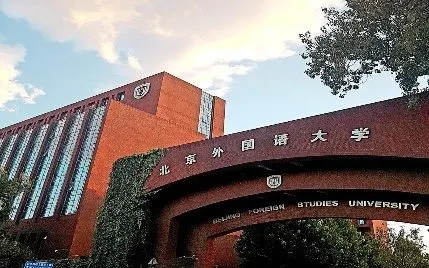
The standard Russian name means ‘Peking University’; this is what Russian Wikipedia, for example, calls the university. Misspelt variants of the Russian name are simply typos. ‘University of Peking’ is a calque of the English: formally it is incorrect, but it often appears in search queries. The official international name Peking University is based on the historical postal romanisation rather than modern pinyin. PKU is the standard abbreviation for rankings and correspondence. Beida (北大, Běidà) is an informal student nickname used both in China and in English-language texts. The original Chinese name is 北京大学 (Běijīng Dàxué), literally ‘Beijing Great University’.
PKU is the official abbreviation of Peking University. It is a public research university in Beijing, founded in 1898; it belongs to the C9 League, an alliance of nine leading Chinese universities often compared to the Ivy League.
Yes, but not everywhere. Some bachelor's programmes and most master's and MBA programmes are taught in English, including the Guanghua Global MBA; the main bachelor's track is in Chinese. PKU's main programmes are not taught in Russian.
For bachelor's admission without written entrance exams, HSK 6 with a score of 210 points or more is required, or an equivalent: UEC Chinese A1 or A2, A-Level Chinese at grade A or above, or IB Chinese HL at 6 or above. For other tracks and levels, the requirements depend on the specific programme.
Yes, and in the top category A. In addition, the university has taken part in Project 211 since 1996 and in Project 985 since 1998.
The price depends on the building and the room category. Check the current cost of accommodation on PKU's official website or with the university's international office.
Yes: both CSC formats are available at PKU: bilateral Type A, where documents go through the embassy, and Type B, the university's quota with the code 10001. Each covers tuition, accommodation and a stipend. Whether there is a quota for the year and programme you want should be checked separately.
PKU accepts HSK results for admission. The schedule of open exam sessions is easier to check in the HSK exam calendar than in the university's general catalogue of departments.
Main campus: No. 5 Yiheyuan Road, Haidian District, Beijing, 100871, near the Summer Palace. The nearest metro station, Peking Univ East Gate on Beijing Metro line 4, is right by the campus's east gate.
BJUT is a municipal engineering university without 211 or 985 status. BNU is a national normal (teacher-training) university; it shares its roots with PKU in the Imperial University of Peking of 1898, but it specialises in education. Compared with them, PKU is a larger comprehensive national university at C9 level.
You will need an international passport, a school certificate and transcript, notarised and translated into Chinese or English, medical forms, a police clearance certificate and proof of financial means. Which language certificate is needed depends on the track you choose.
Beijing (北京) is the capital of China and a major centre of education: the city has more than 90 universities, among them Peking University and Tsinghua University, which rank in the country's top 2. Here you can see the Forbidden City and the Great Wall of China, as well as the modern tech district of Zhongguancun, known as China's Silicon Valley.
Studying in Beijing goes hand in hand with good career prospects: the city hosts the headquarters of major companies and research centres, getting around is easy (the metro has 22 lines), and cultural life is very rich. Parents should know that the capital's infrastructure is highly developed, there are international clinics with Russian-speaking staff, many direct flights leave the city, and students are supported by a well-established system: dormitories are located right on the guarded university campuses.
You work with Nihao Study specialists. They will help you put together a portfolio and a set of documents, draw up a study plan and choose a university or college and a specialty that genuinely interest you.
We take care of every stage of admission, from choosing to enrolment
We will gather, prepare, certify and send your documents to the institution
We will show the admissions committee your strengths
We run training sessions and courses so you can prepare with more confidence
We will help you settle in at the start of your studies and keep moving forward
Nihao Study specialists select universities and colleges that match the applicant's goals and means. We make sure the teachers are practitioners and that the knowledge will be useful in your profession.
We examine curricula, talk to students and teachers and look at which specialties employers need, and use this information to select options for the applicant.
Advisers guide the applicant from the first consultation to enrolment, help build a plan and spot mistakes in time that could get in the way.
The cost of our support depends on the programme and the partner university; you'll get an exact quote after a free consultation.
Get a quoteA free 15-minute consultation: together we will choose a university or college and a programme that suit your goals and budget.
Apply with peace of mind: we handle the documents, deadlines and correspondence with admissions committees, and you save time and energy.
Don't want to wait for a call? Message us in the chat.
Message us in chat