China Academy of Art
University · Hangzhou
Language courses · Bachelor's Degree · Master's Degree
CUZ · 浙江传媒学院

Communication University of Zhejiang accepts international students on programmes in the following fields: arts. Choose the level and programme that suit your goals.
Chinese language study at the university — from a few weeks to a year or longer. Suitable for those starting from scratch or preparing for the HSK before entering a main programme.
self-funded · language programme
Cost: 16 000 ¥/year
The first level of higher education: usually four years of study, specialised subjects, internships and a graduation thesis. It opens the way to working in your field and to a master's degree.
self-funded
Cost: 15 000 ¥/year
Advanced study after a bachelor's degree: research, applied projects and internships. It helps you become an expert in your chosen field and broaden your career opportunities.
self-funded
Cost: 20 000 ¥/year
Communication University of Zhejiang is located in Hangzhou. Nihao Study consultants keep track of the deadlines and admission requirements of this university, and you can always check the most accurate and up-to-date information on its official website.
Come for a face-to-face meeting: together we will go through the requirements, deadlines, documents and study options that suit you.

At the meeting we will look at your situation, tell you which documents to prepare and by when, talk about possible programmes and help you decide on the next step.
Communication University of Zhejiang (CUZ, 浙江传媒学院, Zhèjiāng Chuánméi Xuéyuàn) is a public media university in Zhejiang Province, located in the provincial capital, Hangzhou. It is one of China's two leading specialised universities training professionals for radio, television, film and new media, and is often presented as the southern counterpart of Communication University of China in Beijing. Russian-speaking applicants also come across other versions of the name, translating as 'Zhejiang University of Media and Communications' or 'Zhejiang Institute of Media and Communications': these go back to the university's former English name, Zhejiang University of Media and Communications. Chinese students shorten the name to 浙传 (Zhèchuán), and the official abbreviation CUZ is used in international rankings and email correspondence.
Formally, CUZ awards bachelor's and master's degrees, but the Ministry of Education of the PRC classifies it as an institute jointly run by the province and a ministry, rather than a university at the level of the 211 or 双一流 (Double First-Class) projects. The word University in its English name has become part of the brand, which is why Russian-language catalogues and documents have firmly adopted the rendering 'Communication University of Zhejiang'.

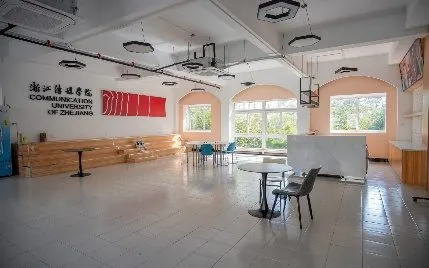
CUZ is a medium-sized university but a highly specialised one: rather than a broad range of fields, it focuses on media, the arts and broadcast engineering. The main figures are given in the table.
| Item | Data |
|---|---|
| Year founded | 1978 |
| Type and founders | Public university; founded by Zhejiang Province and the National Radio and Television Administration of China |
| City | Hangzhou, Zhejiang Province |
| Campuses | Qiantang (Hangzhou) and Wuzhen, 87 hectares in total |
| Colleges and schools | 14 faculties |
| Bachelor's students | over 13,700 |
| Master's students | about 740 |
| International students | over 200 |
| Teaching and other staff | about 1,400 |
| Languages of instruction | Chinese, partly English |
The built-up area of both campuses is approximately 642,000 square metres. The main campus is in Qiantang District, Hangzhou (Zhejiang Province), at 998 Xueyuan Street; the postcode is 310018.
The university traces its history back to 1978, when an institution was opened in Hangzhou to train staff for the province's radio and television. Over the following decades the school expanded its range of programmes step by step, and in 2004 it became a university entitled to award bachelor's degrees; abroad it was then known as Zhejiang University of Media and Communications. Later the English name was changed to the current one, Communication University of Zhejiang, to emphasise its media focus and echo the name of the industry leader in the capital.
CUZ now has two founders: the National Radio and Television Administration of China and the Zhejiang Provincial Government. For a specialised university this is strong administrative backing. Joint provincial and ministerial sponsorship gives direct access to the industry: students have the opportunity to do placements at state TV channels and radio stations, and the university shapes its work around the needs of the province's creative economy. A brief official profile of CUZ in Chinese is available on the university website in the "Institute Profile" section.
It is worth making clear from the start: CUZ does not take part in Projects 211 and 985 or Double First-Class (双一流), so in global rankings such as Times Higher Education it holds a modest position or does not appear at all. This is to be expected for a specialised media university: its standing is determined not by citations of physics papers but by its reputation in the broadcasting and film industry. Objective data on research publications is collected by the aggregator EduRank.
| Ranking (year) | Position |
|---|---|
| EduRank, world (2026) | around 6,310th place |
| EduRank, China (2026) | around 508th place |
| EduRank, Hangzhou (2026) | 13th out of 17 |
| Research publications | 487 papers, 1,726 citations |
| ShanghaiRanking profile | listed, but without a numerical position |
The picture changes if you judge the university by the majors students actually come here for. According to EduRank, CUZ has the most publications in computer science, engineering, the humanities and social sciences, and art and design. The conclusion for applicants is simple: CUZ makes sense if you want a specific media or creative career, not for its overall ranking. Information about the university is also collected by independent directories such as uniRank.
First, broadcasting and announcing. The historical core of the university and the main source of its reputation are its schools of announcing and presenting, journalism, and radio and television broadcasting. Through these programmes CUZ trains staff for state channels; its graduates include well-known Chinese television presenters.
Second, film, television and animation. Students of the College of Film and Television Arts, the School of Animation and the School of Design work in professional studios with equipment for filming and post-production. Hangzhou is the hub of the province's digital and creative economy, and this proximity turns student projects into real practice.
Third, new media and broadcast engineering. The technical foundation for the creative majors is provided by the School of Electronics and Information Engineering together with the School of New Media: here students study software engineering, information technology, networks and broadcasting equipment. Such a combination of humanities and engineering is uncommon for a specialised university.
The university has 14 colleges and schools in total, which can be grouped into several large clusters.
The creative and media core consists of the School of Animation, the College of Film and Television Arts, the School of Cultural Creativity, the School of Journalism and Communication, and the School of Announcing and Presenting. The arts and humanities group includes the School of Music, the School of Design, the School of Literature and the School of Cultures and Communication, which among other things teaches Chinese, English and French. The technical and management group is made up of the School of Electronics and Information Engineering, the School of New Media and the School of Management, which offers arts management, business administration and media economics.
The university awards bachelor's and master's degrees. Bachelor's programmes include arts management, design, fine arts and engineering; master's programmes include journalism, radio and television broadcasting, advertising and arts management. CUZ is therefore a fully fledged institution at bachelor's and master's level, albeit a specialised one.
International students are offered places in modern on-campus dormitories within walking distance of the teaching buildings and studios. Rooms have furniture, air conditioning and internet access.
| Room options |
|---|
| Double |
| Quadruple |
Living in a dormitory with furniture, air conditioning and internet costs considerably less than renting a flat in Hangzhou, and a four-person room remains the most economical option for the first year of study. Check current accommodation fees on the university's official website.
Support for international students in China comes at several levels, and it is worth understanding in advance which of them are realistically available at a specialised university like CUZ. The main options are:
The key point: a specialised institute is not automatically included in the central list of CSC host universities, so before applying, check CUZ's current status in the official list of host universities. If CUZ is not on the central scholarship list in the year you need, a workable strategy is to combine the Zhejiang provincial scholarship with the university's internal scholarships. It is better to think through a realistic plan in advance so that you are not applying blindly.
The CUZ campus is organised differently from that of a typical university. Its centre is not traditional laboratories but sound recording and editing studios, professional television and radio studios, and facilities for filming and post-production. Students take part in real projects from their first years, and for media careers this experience counts for more than any ranking.
Outside classes, students take part in interest clubs, cultural festivals, concerts and student government, while sports clubs and competitions help balance the academic workload. Hangzhou is one of the centres of China's digital economy, so major media companies, internship opportunities and a vibrant city life are close at hand. The main campus is in the Xiasha Higher Education Zone (Qiantang District), from where it is easy to get to other parts of the city.
Most of the confusion arises because there are two "communication universities" in China, and applicants often mistake one for the other. The table compares CUZ with the universities it is most often confused with.
| University (Chinese name) | Status | Main focus |
|---|---|---|
| Communication University of Zhejiang (CUZ), 浙江传媒学院 | Public media institute, Hangzhou | Radio, television, film, new media |
| Communication University of China (CUC), 中国传媒大学 | Project 211 university, Beijing | Leading university of the broadcasting and media industry |
| China Academy of Art, 中国美术学院 | Academy of arts, Hangzhou | Fine arts and design |
| Zhejiang University (ZJU), 浙江大学 | Project 985 and 211 university, Hangzhou | Comprehensive research university |
The main difference is that CUZ is a provincial media institute in Hangzhou, while the similarly named CUC (Communication University of China) is a Beijing-based Project 211 university that ranks higher in the industry hierarchy. CUZ differs from the China Academy of Art in its profile: its focus is broadcasting and screen media rather than fine art as such. And what sets it apart from Zhejiang University, located in the same city, is its narrow specialisation: ZJU is a large comprehensive research university in Projects 985 and 211, whereas CUZ is a specialised media school.
Seven forms are in use altogether. The standard Russian form corresponds to 'University of Communications of Zhejiang', and it is the one used in catalogues and reference books. Russian spellings of Zhejiang with the wrong vowel or without the letters that render 'jiang' are common typos and are best avoided. 'Zhejiang Communications University' is a calque of the English: it is formally inaccurate, although it does occur. The official international name is Communication University of Zhejiang. CUZ is the official abbreviation for rankings and correspondence. 浙传 (Zhechuan) is what Chinese students call the university for short. The original Chinese name is 浙江传媒学院 (Zhèjiāng Chuánméi Xuéyuàn). It is also worth remembering the former name, Zhejiang University of Media and Communications: this is where the Russian forms 'Zhejiang Institute (University) of Media and Communications' come from.
It is a public university in Hangzhou with a media profile: broadcasting, film, journalism and new media. It was jointly founded by the National Radio and Television Administration of the PRC and the Zhejiang Provincial Government.
CUZ does not teach in Russian. The main language of instruction is Chinese, although some courses and programmes may be taught in English. Most fields require an HSK certificate.
For Chinese-taught programmes, aim for HSK 4 or higher; some creative and master's fields may require HSK 5. The university sets the exact threshold every year as part of its admissions campaign.
No. CUZ is part of neither Project 211 nor the 双一流 (Double First-Class) programme. It is a media institute under joint provincial and ministerial administration that trains bachelor's and master's students, not a national-level university. Its strength lies in its industry specialisation rather than formal status.
The price depends on the room type — the campus has twin and four-person rooms. Check the current accommodation cost and the registration fee on the university's official website.
A CSC scholarship covers tuition and accommodation, but it is allocated through a list of host universities, and specialist institutes are not always on it. Before applying, check CUZ's current status in the official list of CSC host universities. If the university is not on the list in the year you need, a realistic alternative is the Zhejiang Provincial Government Scholarship together with the university's own scholarships.
The HSK is held at accredited test centres, and the certificate is presented on admission. Plan to take the test early, checking the exam schedule, so that you have your result in hand by the time you apply.
The main campus is in Hangzhou, in the Xiasha Higher Education Zone of Qiantang District: 998 Xueyuan Street, postcode 310018. A second campus operates in Wuzhen (Tongxiang).
CUC (中国传媒大学) is a Project 211 university in the capital, Beijing, while CUZ is a provincial media institute in Hangzhou that ranks lower in the sector hierarchy. Zhejiang University (ZJU) is part of Projects 985 and 211 and is a classic research university, whereas CUZ focuses on broadcasting and screen media.
You usually need an HSK certificate, a motivation letter, references, an international passport, a school-leaving certificate with its transcript and a certified translation, a medical certificate and photos. Applicants to creative majors also submit a portfolio or a creative exam result.
Hangzhou (杭州) is the capital of Zhejiang Province and home to Alibaba's headquarters. The city is famous for West Lake and renowned for its beauty, and here a long history sits alongside modern technology.
Hangzhou has strong universities — Zhejiang University ranks in the country's top 5 — and its developed IT industry offers internship opportunities. Students can look forward to a good environment, picturesque nature for relaxing, 10 metro lines and a modern 'smart' city where cashless payment is the norm. Parents should bear in mind the high level of safety and quality of life, modern healthcare, the international airport and the proximity of Shanghai — 45 minutes by train. The campuses are well organised, with security and support services for international students.
You work with Nihao Study specialists. They will help you put together a portfolio and a set of documents, draw up a study plan and choose a university or college and a specialty that genuinely interest you.
We take care of every stage of admission, from choosing to enrolment
We will gather, prepare, certify and send your documents to the institution
We will show the admissions committee your strengths
We run training sessions and courses so you can prepare with more confidence
We will help you settle in at the start of your studies and keep moving forward
Nihao Study specialists select universities and colleges that match the applicant's goals and means. We make sure the teachers are practitioners and that the knowledge will be useful in your profession.
We examine curricula, talk to students and teachers and look at which specialties employers need, and use this information to select options for the applicant.
Advisers guide the applicant from the first consultation to enrolment, help build a plan and spot mistakes in time that could get in the way.
The cost of our support depends on the programme and the partner university; you'll get an exact quote after a free consultation.
Get a quoteA free 15-minute consultation: together we will choose a university or college and a programme that suit your goals and budget.
Apply with peace of mind: we handle the documents, deadlines and correspondence with admissions committees, and you save time and energy.
Don't want to wait for a call? Message us in the chat.
Message us in chat University · Hangzhou
Language courses · Bachelor's Degree · Master's Degree