Guangdong Medical University
University · Zhanjiang
Language courses · Bachelor's Degree · Master's Degree
JNU · 暨南大学
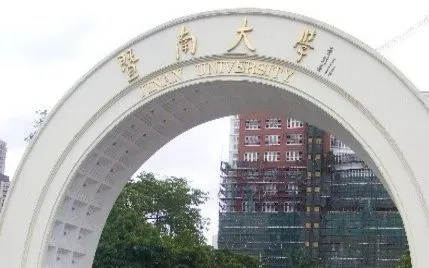
Jinan University accepts international students on programmes in the following fields: engineering, medicine. Choose the level and programme that suit your goals.
Chinese language study at the university — from a few weeks to a year or longer. Suitable for those starting from scratch or preparing for the HSK before entering a main programme.
self-funded · language programme
The first level of higher education: usually four years of study, specialised subjects, internships and a graduation thesis. It opens the way to working in your field and to a master's degree.
self-funded
Advanced study after a bachelor's degree: research, applied projects and internships. It helps you become an expert in your chosen field and broaden your career opportunities.
self-funded
Jinan University is located in Guangzhou. Nihao Study consultants keep track of the deadlines and admission requirements of this university, and you can always check the most accurate and up-to-date information on its official website. In university rankings, it is ranked 61 in China and 553 worldwide.
Come for a face-to-face meeting: together we will go through the requirements, deadlines, documents and study options that suit you.

At the meeting we will look at your situation, tell you which documents to prepare and by when, talk about possible programmes and help you decide on the next step.
Jinan University (JNU, 暨南大学, pinyin Jì'nán Dàxué) is a public comprehensive university of Guangdong Province, located in its capital, Guangzhou. Russian names vary: reference works use a stricter adjectival form, while catalogues for applicants more often use a form meaning "University of Jinan". Chinese students call the university simply 暨大 (Jida, Jìdà), and in international rankings it appears as JNU.
To save time, let us clarify straight away: this page is about 暨南大学 (Jinan University, JNU) in Guangzhou — a historic centre of education for the Chinese diaspora. Universities with a similar spelling are different institutions: University of Jinan (济南大学) is in the city of Jinan in Shandong Province, which is also home to Shandong University (山东大学). JNU holds the title 華僑最高學府 — the leading institution of higher learning for the huaqiao, that is, ethnic Chinese living abroad — and was the first university in China to admit international students.
Below are the key figures and rankings, strongest research fields, programmes, dormitories, scholarships (including CSC), the admission procedure and a detailed explanation of how JNU differs from the similarly named universities in Shandong. Questions about admission can be asked during a Nihao Study consultation.


The table shows the university's main indicators according to the university itself.
| Item | Data |
|---|---|
| Founded | 1906: the 暨南学堂 academy in Nanjing; re-established in Guangzhou in 1958 |
| Status | Comprehensive public university; part of Project 211 and the Double First-Class programme; jointly administered by the United Front Work Department of the CPC Central Committee, the PRC Ministry of Education and the Guangdong provincial government |
| Number of students | about 50,000 full-time students, of whom around 22,500 are undergraduates |
| Students from abroad, Hong Kong, Macao and Taiwan | over 13,500, more than at any other university in mainland China |
| Teaching staff | 1,917 staff, including 4 academicians of the Chinese Academy of Sciences and the Chinese Academy of Engineering |
| Structure | 38 schools, 59 departments, 108 bachelor's programmes |
| Disciplines in the top 1 percent of ESI | 19 fields; pharmacology and toxicology in the top 1 per mille |
| Library | about 3.59 million printed volumes |
| Main campus | Shipai: 601 Huangpu Avenue West, Tianhe District, Guangzhou; postcode 510632 |
| International partners | over 180 universities and institutes in various countries |
JNU dates its history from 1906, when Duanfang (端方), Viceroy of Liangjiang, petitioned the Guangxu Emperor for permission to open a school for the children of Chinese emigrants. This is how the 暨南学堂 (Jinan Xuetang) academy came into being in Nanjing; its first 21 students from abroad enrolled in 1907. The word 暨南 comes from the ancient classic Shangshu and means "to carry learning to the south": to the southern seas and beyond, to the overseas Chinese communities.
Over the following half-century the university's city and status changed more than once. In 1927 in Shanghai it was named National Jinan University, and in 1949 it was dissolved, with its departments transferred to Fudan University and Jiao Tong University. A new chapter began in 1958, when the university was re-established in Guangzhou, closer to the main emigration areas of southern China. The university's motto is the classical formula 忠信笃敬: loyalty, honesty, diligence and respect.
JNU is jointly administered by the United Front Work Department of the CPC Central Committee, the PRC Ministry of Education and the People's Government of Guangdong Province. Since January 2024 its president has been Xing Feng (邢锋), an academician of the Chinese Academy of Engineering. Its historical mission of serving the diaspora explains why JNU still has more students from overseas communities, Hong Kong, Macao and Taiwan than any other university in mainland China.
Looking at international rankings as a whole, JNU is one of China's strong second-tier research universities, and in a number of disciplines, above all pharmacy and biomedicine, it ranks noticeably higher than its overall position. Current positions are shown in the table.
| Ranking | Position (edition year) |
|---|---|
| QS World University Rankings | around 540th worldwide (2026) |
| Times Higher Education, World University Rankings | 501–600 band (2026) |
| U.S. News Best Global Universities | 345th worldwide (2025-2026 edition) |
| CWUR | 394th worldwide (2024) |
| ShanghaiRanking (ARWU) | worldwide: 301–400 band (2025) |
| EduRank | 748th worldwide, 48th in China (2026) |
It is also worth looking at the subject rankings. In ShanghaiRanking's global subject ranking, JNU's biomedical engineering is around 33rd in the world and pharmacy is in the 51–75 band. Applicants in these fields are attracted primarily by the strong subjects rather than the university's overall position.
In several areas JNU competes on equal terms with much larger universities. Below are three fields that make it worth considering.
JNU's most prominent academic field is pharmacy (药学). It was included in the national Double First-Class programme (双一流) in the first selection in 2017 and confirmed in the second, in 2022; no other JNU discipline is on this list. Scientometrics backs this up: according to ESI, JNU's pharmacology and toxicology are in the world's top 1 per mille, and in total 19 of the university's disciplines are in the top 1 percent of ESI.
Another field characteristic of JNU is journalism and communication. The School of Journalism has existed since 1946; the university itself calls its programme one of the five strongest in the country and notes that the discipline is near the top of the Ministry of Education's national ranking. What makes the profile distinctive is that journalists and media professionals are trained here for the Chinese-speaking audience worldwide, which ties directly to the university's role as a centre of diaspora education.
The third field is less conspicuous but largely defines JNU's special character. JNU has a College of Chinese Language and Culture (华文学院), which is a national base for teaching Chinese as a foreign language and a base for language education for Chinese people living abroad. For someone coming to learn the language from scratch, this means not a set of scattered courses but a school with many years of experience and its own textbooks and methods.
JNU's academic structure covers 12 broad fields of knowledge spread across 38 schools. To avoid getting lost among dozens of units, it is convenient to group them by branch of science.
The humanities and languages group includes the School of Translation, the School of Foreign Studies, the School of Humanities and the already mentioned College of Chinese Language and Culture for overseas Chinese. Economics and management is one of the leading areas: it includes the School of Management, the International Business School and the School of Economics, founded in 1980 and one of the oldest in the country. Medicine and pharmacy are represented by the School of Medicine, the First Clinical Medical College and the College of Pharmacy, which underpins the Double First-Class status.
The natural sciences and engineering are concentrated in the schools of environment, chemistry and materials science, electrical engineering, life sciences, information technology and cybersecurity, and science and engineering. Standing apart are the International School, which brings together the English-taught programmes, and a joint institute created by JNU together with the University of Birmingham. As a result, the university covers almost every need of an international applicant, from IT and medicine to international trade and journalism.
Accommodation fees at JNU depend primarily on the campus. There are dormitories on the main Shipai campus in Guangzhou, the South campus, in Zhuhai, in Shenzhen and on the Guangyuan Dong campus (华文学院). Check the current rates for the academic year on the university's official website.
Rooms for international students usually have air conditioning, a bathroom, hot water and internet; accommodation can be single, double or quadruple. On moving in you need to pay a deposit, which is refunded later, and electricity within a monthly limit is free.
JNU accepts Chinese Government Scholarship (CSC) holders; the university's agency number is 10559. Besides CSC, applicants can compete for provincial scholarships and the university's own scholarships. The main options are listed below.
The full CSC scholarship covers tuition, a dormitory place, health insurance and a monthly allowance, the amount of which differs for bachelor's, master's and doctoral students. In total, more than 300 Chinese universities accept CSC scholarship holders.
The Guangdong Provincial Government Scholarship goes to the best international students already studying at the university; it is awarded once a year, in October. The university's own Silk Road Scholarship can be renewed in the first category, but for no more than 4 years of study; for long medical programmes its overall limit is even higher. Future teachers of Chinese can apply for the Confucius Institute Scholarship, which covers tuition, accommodation and living expenses. Combining provincial and university scholarships can allow some students to cover almost the entire cost of study, even when the CSC places are already taken.
The main Shipai campus is in Tianhe, Guangzhou's business district, near the Tianhe Sports Centre and Shipaiqiao station on metro Line 5. This is convenient for study and internships: international companies have offices nearby, and the high-speed train reaches Hong Kong in about an hour.
The campus has a large library of about 3.59 million volumes, a university history museum, laboratories and sports facilities. In Guangzhou's subtropical climate you can do sport almost all year round. Many students have come from other countries and from Hong Kong, Macao and Taiwan, and in such a multinational environment it is much easier for an international student to settle in than at mono-ethnic universities in the north of the country.
International students apply to JNU through the usual procedure for Chinese universities, with the caveat that some applicants apply as overseas Chinese. In outline, the procedure is as follows.
The university announces specific application deadlines every year; for example, the school certificate for the intake must be uploaded by 15 August.
The difficulty for applicants is that 暨南 (Jì'nán, fourth tone) and 济南 (Jǐnán, third tone) sound almost the same, and both are usually written simply as Jinan in Latin letters. As a result, JNU in Guangzhou is often mistaken for one of two quite different universities located in Jinan, Shandong Province.
| University (Chinese name) | Status and city | Main focus |
|---|---|---|
| Jinan University (JNU), 暨南大学: the subject of this page | Public comprehensive university, Guangzhou | The leading university for overseas Chinese; pharmacy and journalism; 211 and Double First-Class |
| University of Jinan (UJN), 济南大学 | Provincial comprehensive university, Jinan (Shandong) | Engineering and materials science; not part of Projects 211 or 985 |
| Shandong University (SDU), 山东大学 | National university under the Ministry of Education, Jinan (Shandong) | One of China's oldest universities; Projects 211 and 985 and Double First-Class |
The difference is easy to remember: overseas Chinese, the diaspora and Guangzhou mean 暨南大学 (JNU). The city of Jinan in Shandong means either 济南大学 (University of Jinan) or the much larger 山东大学 (Shandong University), which is in the same city. The first character settles it: for JNU it is 暨, not 济.
There are two standard Russian forms, translating as 'Jinan University' (adjectival) and 'University Jinan'; they are used by Wikipedia and reference books. Spellings with 'Dzh' and without the soft sign are common mistakes and best avoided. 'Dzhinan Yuniversiti' is a transliterated calque of the English: strictly speaking it is incorrect, although you may come across it in chats. Jinan University is the official international name, JNU is the official abbreviation for rankings and e-mail, 暨大 (Jida) is the student short form in China, and 暨南大学 (pinyin Jì'nán Dàxué) is the original name. The main thing is not to confuse 暨南大学 with 济南大学 (University of Jinan) in Shandong.
JNU is Jinan University (暨南大学) in Guangzhou. It was founded in 1906 specifically to educate the children of Chinese emigrants. It is called the leading university for huaqiao; moreover, it was the first in China to admit international students, which is why it still has more students from abroad, Hong Kong, Macao and Taiwan than any other university in mainland China.
Yes. JNU's International School offers around nine bachelor's programmes taught in English and two master's programmes, including clinical medicine (MBBS). Even so, most programmes are taught in Chinese, and medical students on the English-taught track still need HSK 4 by graduation for their clinical practice.
Chinese-taught programmes usually require HSK 5 with a score of at least 180; with this certificate you do not need to sit the university's own entrance exam. Check exam session dates against the official HSK schedule.
Yes, JNU is part of Project 211 and the Double First-Class initiative, in which it is represented by pharmacy (药学): the discipline was selected in 2017 and confirmed in 2022. The university is not in the 985 group — it only took part in the “985 Innovation Platform for Disciplines”.
The fee depends on the campus and room type; the university publishes the current rates for the academic year on its official website.
Yes. JNU accepts Chinese Government Scholarship holders under agency number 10559; the full scholarship covers tuition, accommodation and insurance and includes a monthly allowance.
暨南大学 (JNU) is a university in Guangzhou and a centre of education for the Chinese diaspora. 济南大学 (University of Jinan) is a separate provincial university located in Jinan (Shandong province). 山东大学 (Shandong University) is yet another, much larger national university, also based in Jinan. All they have in common is how the names sound in Cyrillic; the characters and the cities are different.
Main Shipai campus: 601 Huangpu Avenue West, Tianhe District, Guangzhou, postcode 510632. The nearest metro station is Shipaiqiao on Line 5. Besides the main campus, the university has campuses in Panyu, Zhuhai and Shenzhen.
As a rule, you need a passport, a secondary school certificate and transcript, an HSK certificate or proof of English, photos, a medical certificate, recommendation letters and proof of financial support; an application fee is also payable. Applicants must be foreign nationals, have no criminal record and be in good health.
Yes, this is one of the university's defining features. It has more than 13,500 students from abroad, Hong Kong, Macao and Taiwan — more than any other university in mainland China — and JNU graduates come from more than 170 countries and regions. For an international student, this means a well-established support system and a multicultural environment the university has long been used to.
Guangzhou (广州) is the capital of Guangdong Province and the trade gateway of southern China. The large-scale Canton Fair is held here twice a year. Cantonese cuisine originates here, and the city remains a centre of international business.
Here it is easy to combine study with work experience: thousands of export companies operate in the city. The metro has 16 lines, the environment is multinational, and the subtropical climate allows you to play sport all year round. Parents will care about other things: the city is safe, Hong Kong is 1 hour away by high-speed train, there are international hospitals and schools and direct international flights, and the campuses are well run, with security on duty around the clock and dedicated services to help international students.
You work with Nihao Study specialists. They will help you put together a portfolio and a set of documents, draw up a study plan and choose a university or college and a specialty that genuinely interest you.
We take care of every stage of admission, from choosing to enrolment
We will gather, prepare, certify and send your documents to the institution
We will show the admissions committee your strengths
We run training sessions and courses so you can prepare with more confidence
We will help you settle in at the start of your studies and keep moving forward
Nihao Study specialists select universities and colleges that match the applicant's goals and means. We make sure the teachers are practitioners and that the knowledge will be useful in your profession.
We examine curricula, talk to students and teachers and look at which specialties employers need, and use this information to select options for the applicant.
Advisers guide the applicant from the first consultation to enrolment, help build a plan and spot mistakes in time that could get in the way.
The cost of our support depends on the programme and the partner university; you'll get an exact quote after a free consultation.
Get a quoteA free 15-minute consultation: together we will choose a university or college and a programme that suit your goals and budget.
Apply with peace of mind: we handle the documents, deadlines and correspondence with admissions committees, and you save time and energy.
Don't want to wait for a call? Message us in the chat.
Message us in chat University · Zhanjiang
Language courses · Bachelor's Degree · Master's Degree

University · Guangzhou
Language courses · Bachelor's Degree · Master's Degree