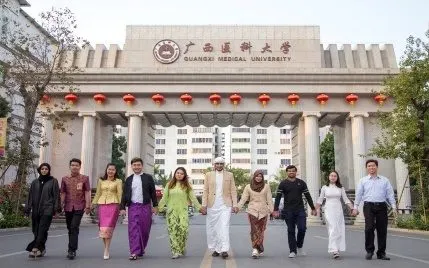
Guangxi Medical University
University · Nanning
Language courses · Bachelor's Degree · Master's Degree
GUFL · 广西外国语学院
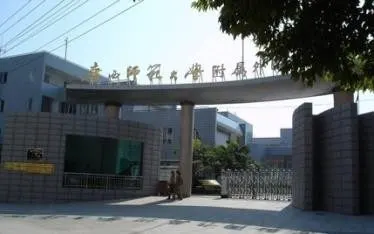
Guangxi University of Foreign Languages accepts international students on programmes in the following fields: medicine. Choose the level and programme that suit your goals.
Chinese language study at the university — from a few weeks to a year or longer. Suitable for those starting from scratch or preparing for the HSK before entering a main programme.
self-funded
Cost: 10 000 ¥/year
Guangxi University of Foreign Languages is located in Nanning. Nihao Study consultants keep track of the deadlines and admission requirements of this university, and you can always check the most accurate and up-to-date information on its official website.
Come for a face-to-face meeting: together we will go through the requirements, deadlines, documents and study options that suit you.

At the meeting we will look at your situation, tell you which documents to prepare and by when, talk about possible programmes and help you decide on the next step.
Guangxi University of Foreign Languages (GUFL, 广西外国语学院, Guǎngxī Wàiguóyǔ Xuéyuàn) is a private university specialising in languages, located in Nanning, the capital of the Guangxi Zhuang Autonomous Region in southern China. It is the only stand-alone language university in Guangxi with bachelor's-level status, and it leads the region's other language universities in both student numbers and the number of languages taught. Nanning hosts the China-ASEAN Expo every year, so foreign languages here are learnt through direct contact with students, teachers and businesspeople from South-East Asia.
Russian-speaking applicants usually use a Russian name meaning "Guangxi University of Foreign Languages"; a variant that copies the English word order is less common. Chinese students simply say 广西外院 (Guǎngxī wàiyuàn) among themselves, international rankings list the university as GUFL, and in Russian-language documents the full name is the norm. It is important not to confuse Guangxi with Guangdong: the province names sound alike, and as a result their universities are often mixed up too.
The table shows the main facts about GUFL. They are based on the university's official website and independent sources; each point is covered in more detail in the sections below.
| Indicator | Data |
|---|---|
| Chinese name | 广西外国语学院 (Guǎngxī Wàiguóyǔ Xuéyuàn) |
| English name | Guangxi University of Foreign Languages (GUFL) |
| Type of institution | Private (民办), bachelor's level |
| Founded | 2004; university status since 2011 |
| City | Nanning, Guangxi Zhuang Autonomous Region |
| Number of students | more than 32,000 (2025) |
| Campuses | 2 (Nanning and Fusui) |
| Languages taught | 12 |
| Official website | english.gxufl.edu.cn |
Its history dates back to June 2004, when the board of founders set up a vocational college, 广西东方外语职业学院 (roughly, Guangxi Oriental Vocational College of Foreign Languages), in the Wuhu university town in Nanning. Within seven years it had become a fully fledged university: in April 2011 the college became a full-time private university offering bachelor's degrees and changed its name to the current one. In 2014 the Guangxi Academic Degrees Committee confirmed its right to award bachelor's degrees.
The next stages are typical of a successfully developing private university. In 2018 the Ministry of Education of the PRC audited the quality of its bachelor's programmes, and GUFL passed. In September 2021 the university was approved to prepare for status as a master's degree-awarding institution. In other words, GUFL today is not just a place for language courses but a university with bachelor's programmes that is building its own master's provision.
A special chapter in GUFL's history is linked to its founder Zhu Guiling (朱桂玲), chair of the board of founders. She built the university on the idea that a graduate should know not only the language of neighbouring countries but also their culture. She personally developed the university's ties with Thailand and Vietnam, and it was for this that a Thai university awarded her an honorary doctorate. Hence GUFL's motto — Chinese-souled, International-minded: a Chinese soul and an international outlook. Over twenty years GUFL has focused on the Belt and Road Initiative and cooperation with ASEAN, and this specialisation defines its character today.
The Chinese name ends in 学院 rather than 大学 — a detail worth knowing in advance. The characters 大学 are usually rendered as "university", while 学院 is rendered as "institute" or "college". However, the institution's official international name is University of Foreign Languages, so that is the name used here.
In practice, GUFL is an independent private (民办) university: it awards bachelor's degrees and also teaches 专科 programmes — an applied diploma that takes two or three years. This fundamentally distinguishes it from departments with similar words in their names. For example, a 外国语学院 within another university is merely that university's school of foreign languages, not a separate institution. More on such cases in the section on universities with similar names.
GUFL is a young private university, so it holds no national statuses — membership of Project 211 or 985 or of the Double First-Class (双一流) programme: these are awarded mainly to large public research universities. Nor should you expect a private language university to rank highly in global research rankings, which primarily count academic publications. Its strengths lie elsewhere — they are described below.
GUFL focuses on applied training rather than research, so it ranks low in global academic rankings: such lists assess mainly the number of academic publications, not how languages are taught. In the EduRank aggregator for 2026, the university sits in the lower part of the overall table — which is to be expected for a young private university.
| Ranking (year) | Position |
|---|---|
| EduRank, world (2026) | 11,881 of 14,131 |
| EduRank, China (2026) | 903 of 960 |
| EduRank, Nanning (2026) | 8 of 9 |
| uniRank, China | 652 |
It is fairer to look at GUFL in the lists where it genuinely competes: subject rankings and rankings of private universities. In the subject rankings of the Chinese Universities Alumni Association (校友会), several of the university's language programmes are among the strongest in the country. In 2026 GUFL's Thai language programme came second nationally; previously two of its programmes received the top rating of five stars, and another six received four stars. There are results in international work too: according to the university, in the 京领 (Kinglead) ranking, which assesses the internationalisation of private universities in China, GUFL took first place in the country two years running. For those going specifically for languages, these indicators say more than a position in the overall global list.
Specifically, there are three reasons to choose this university.
First, the languages of Southeast Asia. GUFL teaches twelve languages in total: alongside English, French, Spanish, German and Japanese, students learn Thai, Vietnamese, Lao, Khmer, Burmese and Indonesian. In the specialist subject rankings, the university's Vietnamese, Thai and Khmer programmes are consistently among the leading ones in the country. You can study these less widely spoken ASEAN languages with native speakers, as well as with teachers who have worked in neighbouring countries.
Second, the surroundings. Nanning is the permanent host of the China-ASEAN Expo and China's "gateway" to Southeast Asia. For students this means real practice: internships, part-time interpreting at forums, and contact and exchanges with peers from ASEAN countries. If you are planning a career in trade or logistics between China and Southeast Asia, this environment works in your favour. The regional focus is also built into the university's structure: according to the university, GUFL has an ASEAN Institute of Arts, an ASEAN Institute of Digital Economy, an ASEAN Institute of Languages and Culture, and a research centre studying the use of artificial intelligence in language teaching. There is also a China-ASEAN Student Innovation and Entrepreneurship Park. The university opens internship and employment sites directly in Thailand, Vietnam, Cambodia and Indonesia.
Third, the low entry threshold. No HSK certificate is needed to start a language programme, and the minimum education is completed lower secondary school (nine years). Tuition is relatively moderate for a specialist university. This makes GUFL suitable as a first step into Chinese education — especially for those who want to improve their language first and only then decide on a bachelor's degree.
The university has sixteen teaching schools (二级学院). They run forty-six bachelor's programmes and around twenty applied programmes at 专科 level. At bachelor's level there are twelve language programmes, and at 专科 level another ten.
The fields of study can be roughly divided into several groups. Foreign languages form the core; among them, Asian languages (Thai, Vietnamese, Khmer, Burmese, Lao, Indonesian) are given particular prominence, alongside European languages and Japanese. Applied programmes are built around this language core: economics and management, international business and trade, art, design, information technology, and education and teacher training. The "language plus profession" combination reflects the university's aim: to produce not general-purpose translators but specialists for specific tasks in trade and exchanges with ASEAN countries. GUFL's main discipline is foreign languages and literature, within which Asian languages are designated a key regional field. International students study at a separate International College; its majors include cross-border e-commerce, international economics and trade, economics and finance, taxation, hotel management, marketing and Teaching Chinese to Speakers of Other Languages (TCSOL). According to the university, GUFL has more than two thousand international students in total — a notable figure for a private language university.
The dormitory for international students is right on campus: 19 Wuhu Avenue, Qingxiu District. There are double and single rooms; current accommodation prices are best checked on the university's official website english.gxufl.edu.cn.
The residential buildings belong to the Wuhu campus in Nanning. GUFL's second campus (空港, near the airport) is located in Fusui County.
China's main government scholarship — the CSC scholarship — is distributed primarily through public universities. Their list is clearly defined, and private universities are usually not on it. This means you are unlikely to enter GUFL completely free of charge through the CSC; the usual option is a self-funded language programme at a moderate cost.
That said, the university has its own forms of support: its admission rules for international students include a section on university scholarships. Conditions and amounts change from time to time, so check them directly when applying — that way you will know what discount or award you can expect in your case.
Nanning is the administrative centre of the Guangxi Zhuang Autonomous Region. The city is famous for its abundant greenery, hence its nickname "Green City" (绿城). According to the 2020 census, the prefecture-level city had a population of about 8.74 million. The climate is humid subtropical: an annual average of about 22 degrees, mild winters and hot summers. Those who struggle with the cold will find it noticeably more comfortable here than in northern China.
The city is convenient for students: the metro has been running since 2016, and Nanning Wuxu International Airport provides connections to other regions of China and neighbouring countries. What sets Nanning apart is its role as China's "gateway" to ASEAN and the permanent venue of the China-ASEAN Expo; thanks to this, an international environment has developed around the university that is unusual for a city of this size. According to the university, the campus is equipped for language practice: there is a virtual simulation centre, an interactive multimedia studio and a visual simultaneous interpreting lab. Studies are complemented by intercultural events — from the Thai festival of Loi Krathong and Guangxi's Sanyuesan (三月三) to an international cultural festival.
The application process for a language programme consists of several consecutive stages.
If you are also considering Chinese-taught programmes, plan your HSK exam well ahead: you will need a level 4 certificate for the relevant intake.
Several major universities in Guangxi have similar-sounding names, so they are often mistaken for one another. The table lists the main ones so it is clear which university is meant.
| University (Chinese name) | Type | Main focus |
|---|---|---|
| Guangxi University of Foreign Languages, GUFL, 广西外国语学院 | Private | Foreign languages, including ASEAN languages |
| Guangxi University, GXU, 广西大学 | Public, Project 211 | Leading comprehensive university in Guangxi |
| Guangxi Minzu University, 广西民族大学 | Public | ASEAN languages, ethnology |
| Guangxi Medical University, 广西医科大学 | Public | Medicine |
Two points are important. First: GUFL (广西外国语学院) is an independent private university. It should not be confused with the School of Foreign Languages of the public Guangxi University: that is called 广西大学外国语学院 and is a faculty, not a separate institution. Second: GUFL has no connection with 广东外语外贸大学 — Guangdong University of Foreign Studies in neighbouring Guangdong Province — although the similar-sounding Guangxi and Guangdong are often confused. In short: GUFL is a private language university in Nanning focused on ASEAN, while the other universities in the table are public and have different profiles.
There are seven variants in all. For Russian-language documents the standard form is the one meaning 'Guangxi University of Foreign Languages'. The variant with 'Guangdong' (Guangdong University) is a mistake: Guangdong is a different province with a different university. The form 'University of Foreign Languages of Guangxi' follows English word order; it does occur but is considered less correct. Guangxi University of Foreign Languages is the official international name, and GUFL is the abbreviation used in rankings and correspondence. 广西外院 (Guǎngxī wàiyuàn) is the abbreviation used by students, and 广西外国语学院 (Guǎngxī Wàiguóyǔ Xuéyuàn) is the original Chinese name.
GUFL is Guangxi University of Foreign Languages, a private university in Nanning specialising in languages. Its Chinese name uses the word 学院 ('institute'), but it officially awards bachelor's degrees and its international name says University, so both terms are acceptable.
Private (民办). It was founded by a board of founders in 2004 and was the first private institution in Guangxi to gain bachelor's-level status. It was accredited by the Education Department of the Guangxi Zhuang Autonomous Region.
GUFL has no Russian-taught programmes for general admission. It is a language university: the main track for international students is Chinese from scratch, along with programmes taught in Chinese or in the foreign language being studied. Japanese, German, Spanish, French and English are taught here as foreign languages.
No HSK certificate is needed to enter the language programme. Chinese-taught programmes require HSK level 4 with a score of at least 180 points.
No. It is a young private university and does not hold the national 211, 985 or Double First-Class (双一流) statuses, which are usually held by large public universities. GUFL's strength lies in ASEAN languages rather than in research rankings.
The price depends on the room type: the dormitory has double and single rooms. Current rates are published on the university's official website.
Usually not: CSC scholarships are allocated through public universities, and private institutions are generally not part of this system. However, GUFL's admission rules have their own section on scholarships, and it is worth checking its terms when you apply.
Yes. The university has a school of international education that prepares students for the HSK exam and administers it.
The main campus is in Nanning, at 19 Wuhe Avenue, Qingxiu District. The easiest way to reach the city is to fly into Nanning Wuxu International Airport, and you can get around the city by metro. GUFL's second campus is in Fusui County, not far from the airport.
GUFL (广西外国语学院) is a private university specialising in languages. Guangxi University (广西大学) is the region's public comprehensive flagship and a Project 211 member. Guangxi Minzu University (广西民族大学) is also public, with strong programmes in ASEAN languages and ethnology.
International applicants need an international passport, an education document (at minimum, completion of lower secondary school) and a photo. Applications are submitted through the university's official portal.
Nanning (南宁) is the capital of the Guangxi Zhuang Autonomous Region. It is called China's 'Green City': trees here keep their leaves even in winter. The city serves as a centre of cooperation between China and ASEAN countries such as Vietnam and Thailand.
In Nanning, students can expect a tropical climate and an international atmosphere: many young people from Southeast Asia study here. The fruit trade is well developed, and the leafy city is pleasant to explore on foot. Parents value the warm, snow-free winters, the abundance of fresh produce all year round, safety and the easy journey to Vietnam and China's southern provinces.
You work with Nihao Study specialists. They will help you put together a portfolio and a set of documents, draw up a study plan and choose a university or college and a specialty that genuinely interest you.
We take care of every stage of admission, from choosing to enrolment
We will gather, prepare, certify and send your documents to the institution
We will show the admissions committee your strengths
We run training sessions and courses so you can prepare with more confidence
We will help you settle in at the start of your studies and keep moving forward
Nihao Study specialists select universities and colleges that match the applicant's goals and means. We make sure the teachers are practitioners and that the knowledge will be useful in your profession.
We examine curricula, talk to students and teachers and look at which specialties employers need, and use this information to select options for the applicant.
Advisers guide the applicant from the first consultation to enrolment, help build a plan and spot mistakes in time that could get in the way.
The cost of our support depends on the programme and the partner university; you'll get an exact quote after a free consultation.
Get a quoteA free 15-minute consultation: together we will choose a university or college and a programme that suit your goals and budget.
Apply with peace of mind: we handle the documents, deadlines and correspondence with admissions committees, and you save time and energy.
Don't want to wait for a call? Message us in the chat.
Message us in chat University · Nanning
Language courses · Bachelor's Degree · Master's Degree
University · Guilin
Language courses · Bachelor's Degree · Master's Degree

University · Nanning
Language courses